The Virtual Stage · Feature
The Set Grows with the Room: Scenography in 25 cm Tiles
Tank Avenger leaves the set design to an algorithm and your own floor. We ask whether scenography can work without a scenographer.
By The Editors · · 5 min read
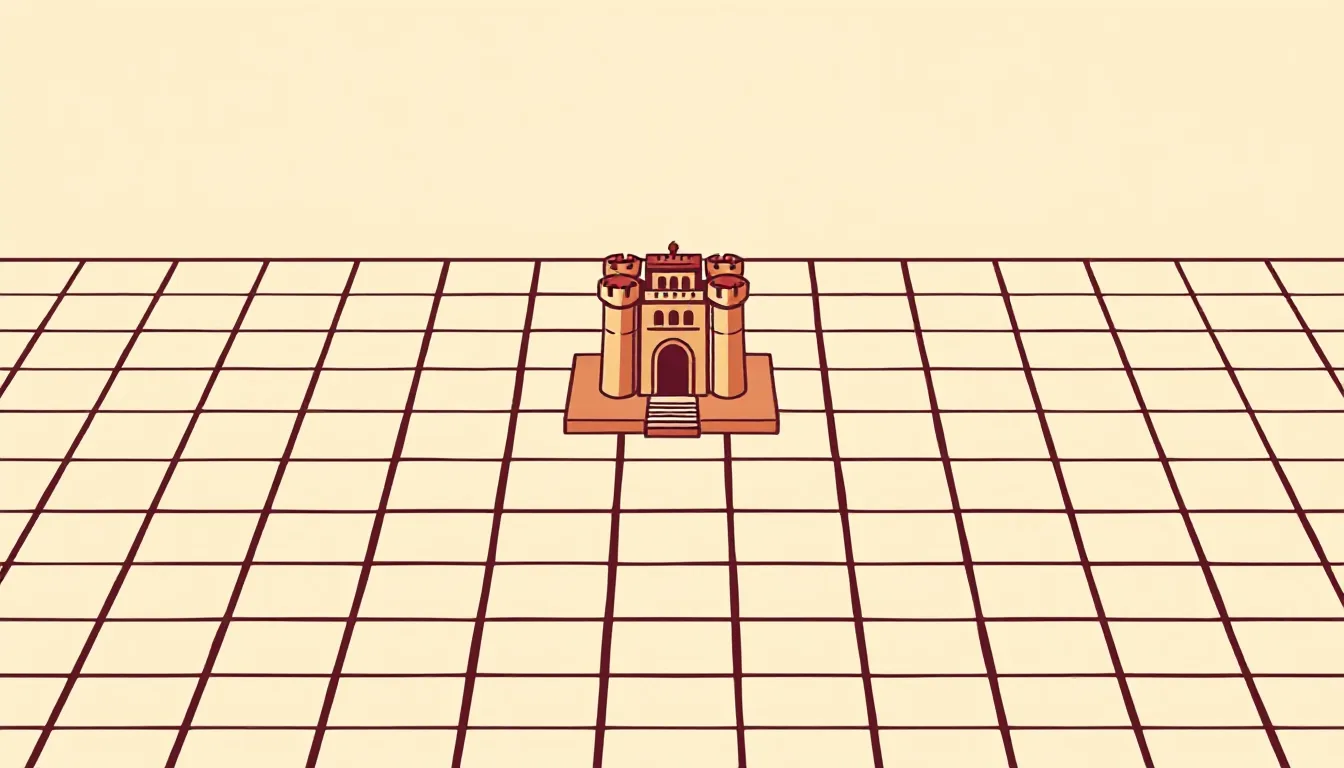
In the theatre, every production begins with a ground plan. The set designer knows the dimensions of the house, the sightlines from the circle, the position of the wings. Only then does the model at one-to-twenty-five scale appear, to be passed around at rehearsals. In Tank Avenger, a mixed-reality tank game for the Meta Quest, this process is turned on its head. The ground plan is the player’s living room, and the model comes into being only at the moment of play.
That raises a question that reaches beyond the game: can a set of rules take over the work of a scenographer?
The Ground Plan: Tiles Instead of Chalk
Before any tank rolls, the game demands a kind of technical rehearsal. The Quest has scanned the room, and on the ‘RECON’ screen the floor appears as a grid of tiles 25 centimetres square. All begin lit. With the trigger held, you switch off tiles that should not be part of the playing area; a stroke that begins on a dark tile switches it back on. Tiles under furniture glow red and remain locked.
Beside it, a hologram of your own room rotates on a turntable: green tiles, translucent furniture blocks, a marker for your own position. So you see at once the real floor and its model, just as a director at rehearsal looks back and forth between stage and set model.
The rules are strict. At least 24 lit tiles, that is 1.5 square metres, and a clear area of at least 0.6 by 0.6 metres. Also only one contiguous area: if two islands form, the smaller goes dark. This is not pedantry but stage logic. A play that takes place on two separate platforms needs a bridge, and there is none here.
The Fortress Goes Where There Is Space
It gets interesting when the ground plan becomes a level. The main fortress of each level lands on the largest free rectangle, facing the player. Outposts are distributed over the remaining floor. If one does not fit, its tank appears elsewhere, so that the number of enemies stays the same. Around the lit area runs a fence in the style of the respective world.
In theatrical terms, this is a mixture of a fixed repertoire and a touring production. The staging — number of enemies, weapon and mode — is fixed. The set adapts to every house it visits. A smaller area means more crowded battles. A touring theatre knows this principle: in a studio theatre the company draws closer together, in a large auditorium it has room to breathe.
The staging is fixed; the set plays a new engagement in every living room.
The Scenery Beyond the Footlights
The game does not stop at the fence. Each of the four worlds builds a small environment on the real floor around the playing area, never on the lit tiles and never on furniture. In Town stand a clock tower, a church and a windmill whose sails turn faster as you pass. In Desert tumbleweeds roll, which you can kick away with your foot. In Jungle birds flutter up as you approach. In Ice snow falls across the whole room, and penguins hop when you win.
That is the real scenographic achievement. A playing area alone would be a board; the scenery around it makes it a world. Lamps and torches light up one after another at the start of a level, like the house lights dimming before the first act and the stage lights coming up.
What the Piece of Furniture May and May Not Do
Here the game deserves praise for its honesty. Furniture blocks tiles and therefore construction; physically, however, it is no obstacle. Tanks and shells collide only with the game’s walls. The sofa is thus neither mountain range nor bunker, but simply not part of the performance.
One could read this as a missed opportunity. A game that used the coffee table as a plateau would sound more exciting at first. We think the decision is right. First, the playing area remains clearly visible and walkable. Second, an algorithm that used furniture as terrain would have to cope with every sofa height and every crooked side table. The restriction to the floor is the decision of a set designer who knows that an empty stage carries more than a cluttered one. Peter Brook wrote a whole book about that.
Algorithm Instead of Design: The Limits
And yet something is missing. A human scenographer might have placed the fortress in the corner of an L-shaped area to stage a dead end. The algorithm takes the largest rectangle. It is fair, but not bold. The levels are built by hand; their arrangement in the room is not. Whatever dramaturgy emerges is a by-product, not a plan.
The minimum size is also a limit. The studio FAQ recommends about two by two metres of clear space. Those with less get very tight battles or fall back on VR mode, which builds a fixed battlefield of 3.5 by 3.5 metres in a virtual landscape. There, however, attack drones and the atomic bomb are missing.
Practical, by contrast, is the memory: the selection is saved and offered again for the same room. If the scan recognises several rooms, the game lists them and selects the one you are standing in. Via ‘+ NEW SCAN’ the room can be re-measured. Anyone who has, say, moved a rug can update the ground plan without rehearsing the play anew.
A Set Designer Without Vanity
In the end, Tank Avenger‘s room adaptation is less a work of art than a good set of house rules. It respects the room, uses every free tile and claims nothing it cannot deliver. Anyone thinking of Es Devlin’s grand sets will find no revelation here. But anyone who has ever tried to set up a model railway in a period living room between radiator and bookshelf will appreciate the modesty of this algorithm.
It is scenography as a service: unobtrusive, reliable and a little different in every room. Anyone who would like to try their own living room as a stage can find Tank Avenger in the Meta Horizon Store.