The Virtual Stage · Review
Tank Avenger: A war in doll's-house scale, staged on your own floor
A tank war nine centimetres tall, staged on the living-room floor: Tank Avenger is smaller than it sounds and bigger than it looks.
By The Editors · · 6 min read
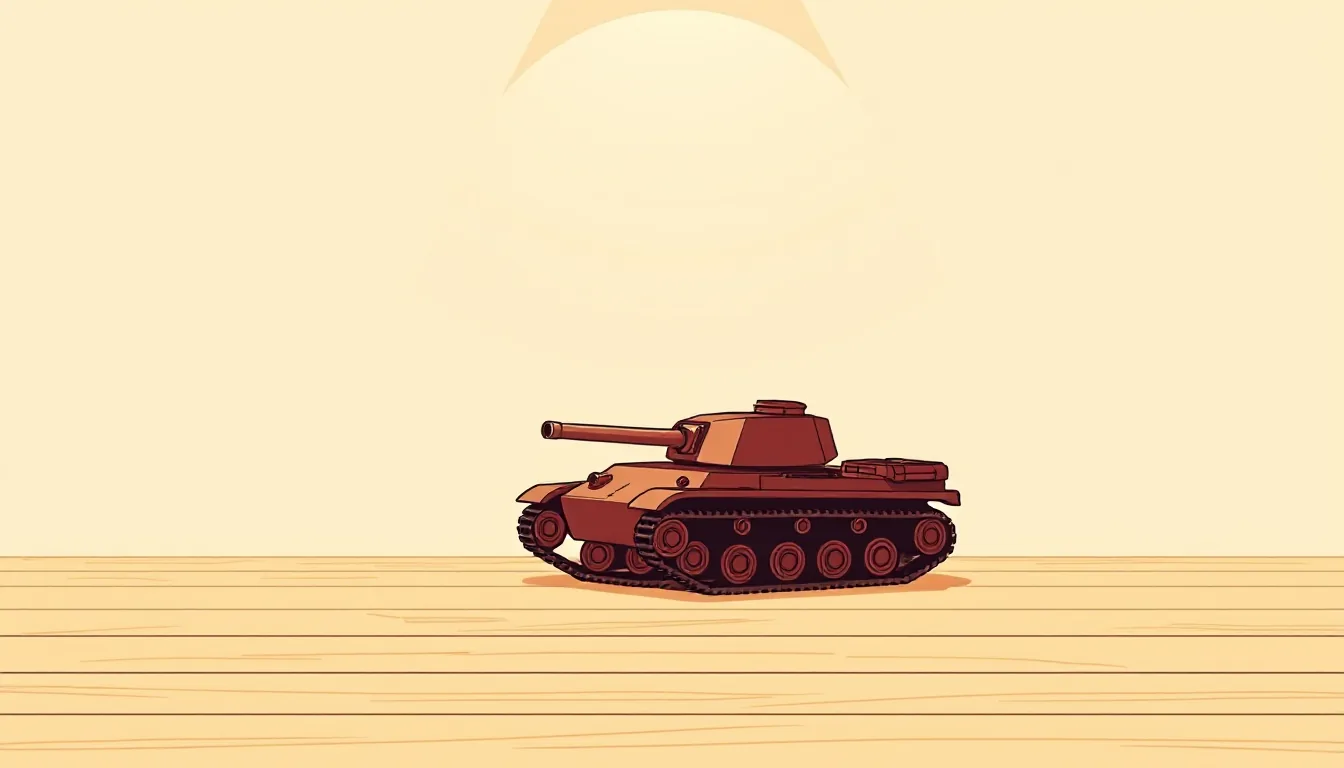
There is a British tradition of refighting great wars on small surfaces. Entire generations have pushed tin soldiers across the kitchen table, and H. G. Wells even wrote a rulebook for it in Little Wars, so that adults could play at war on the carpet without having to feel ashamed of it. Tank Avenger – Mixed Reality, a Quest game from developer Special Games, published by ThreeFlavors LLC, stands in that tradition. Except that this time the carpet itself becomes the map, and the soldiers shoot back.
We wondered whether a tank about nine centimetres long could carry a whole evening at the theatre. The short answer: surprisingly often, yes.
The stage is the floor
The basic idea is so simple that one almost overlooks it. The Quest scans the room, and you then ‘paint’ the part of the floor where the battle is to be fought, in tiles of 25 centimetres. It must be at least 1.5 square metres, plus a clear area of 0.6 by 0.6 metres. On the largest free rectangle the game builds a miniature fortress; over the rest it distributes outposts and enemy tanks. Furniture is left out; nothing is built there.
That has a pleasing consequence: no living room gets to see the same production. A narrow London rental produces cramped skirmishes; a generous dining room, more open battles. It is a set that adapts to the auditorium, not the other way round.
Just as clever is what the game does not do. It does not claim that the sofa is a mountain range. Tanks and shells ricochet only off the game’s walls, never off real furniture. That is more honest than some of the genre’s promotional images, and it keeps the illusion clean: the game takes place on the floor, not in the room.
A set that adapts to the auditorium, not the auditorium to the set.
The player as commander and extra
You control it with the controllers, in a way that is initially unfamiliar: the left stick drives the tank relative to your own line of sight, the right controller aims a beam at the floor, the trigger fires. So you stand above the battlefield and walk around it, like a general over a sandpit or a child over a model railway. There is no artificial camera movement. In the store the game is rated ‘Comfortable for most’, which suits this overhead view.
The real point of the format is the moments when the body joins in. Attack drones rise from a launch pad beside the playing field and hang from a cable that you must cut with the controller; grenades are no use. And occasionally the battle freezes because a hand-sized nuclear warhead is sinking towards your own tank. You have to grab it and throw it out of the play area, or the round is lost. That is slapstick in the best sense: a gesture that looks silly in the living room and feels like a heroic deed in the headset.
Four worlds, four modes, seven weapons
The scope is considerable for a game in this price bracket. 202 levels are spread across four chapters: Town (1–54), Desert (55–108), Jungle (109–162) and Ice (163–202). Each world brings its own walls, crates, soft ground and a small backdrop around the playing field, from church tower to ice castle. In the Ice chapter the tanks even slide, and snow falls through the whole room.
Each level has a fixed mode: Deathmatch (118 levels), Capture the Flag (39), Tank Hunt against the boss tank Juggernaut (30) and Airdrop Assault with waves of parachute tanks (15). The weapon is also assigned, not chosen: Cannon, Ricochet gun, Rapid fire, Triple shot, Heavy cannon, Mortar or Homing missile. At first this sounds patronising, but it makes dramatic sense. A director casts the role; the actor does not choose it. Each level thus becomes a small task with a fixed tool, and the mortar, which aims over walls at a ground reticle, demands completely different thinking from the Ricochet gun with its bank shots.
Where the staging slackens
A critic who only praises is an advertising copywriter. So, to the weaknesses.
First: Tank Avenger is a solo piece. There is no multiplayer mode, no leaderboards and no sharing of self-built maps. Anyone imagining a family evening with four commanders around the same carpet will be disappointed. The family can watch; it cannot join in.
Second: across 202 levels the vocabulary repeats itself. The chapter finales pile up gunship helicopters, the nuclear bomb, drones and outposts to good effect, but in between there are stretches in which the game runs through variations rather than telling us anything new. We do not claim to have seen every level on every difficulty setting; the pattern, however, is clear.
Third, the practical conditions. According to the store listing, an internet connection is required, and the mixed-reality version needs clear, well-lit floor space. For cramped rooms there is a VR mode with a fixed battlefield of 3.5 by 3.5 metres in a themed world, but that is precisely where drones and the nuclear bomb are missing — the most physical scenes of all. And the interface is English only.
The craft in detail
What convinces us most is the care in the small details. Enemy tanks plan their own bank shots. EMP tanks fire rockets that disable either the right hand, the left hand or the drive, and you feel that literally in the controller. In the garage you buy upgrades with coins for each weapon and the vehicle, and they become visible on the model. A map-building kit, the Map Workshop, allows custom Deathmatch maps. Every match begins with a safety briefing that has been staged not as an obligation but as a small scene. PEGI 7 and the EASY difficulty setting make the game family-friendly; HARD and the boss fights keep the ambitious hooked.
According to the British Meta store listing, on 10 October 2026 the game cost £9.99, version 0.4.0, and supports Quest 2, Quest Pro, Quest 3 and Quest 3S. For those who want to read more: Tank Avenger in the Meta Horizon Store.
A doll’s house with gunsmoke
Henrik Ibsen described the doll’s house as a place where one can settle in for too long. Tank Avenger has the opposite problem: it invites war into the doll’s house and makes of it a pleasure that can be put away again after every round. The engagements are short, the stage is honest, and the best moments belong to the body, not the thumb.
4.6 stars, then, and we do not give them lightly. The full five remain in reserve until the piece lets more than one performer on to the stage and tells its middle acts more tightly.